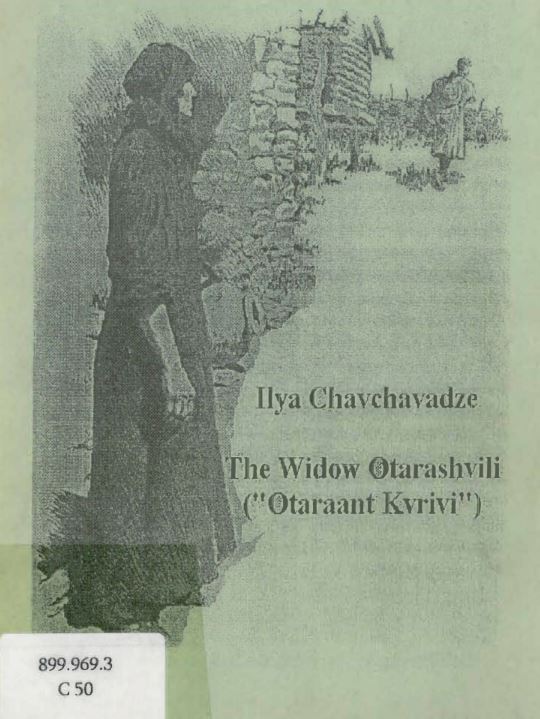
The widow Otarashvili: ("Otaraant kvrivi")
Ilya Chavchavadze | 1993


In order to fully understand the meaning of this story that at first glance seems so naive, but is actually most complicated, in order to find a clue to this understanding, one might regard as a starting point the fact that among Ilya Chavchavadze's close associates the principal character in the story, the widow "Otaraant kvrivi", was usually compared with the author; the same monolithic, inflexible nature, the same stern spirit, the same militant attitude to the world, and the same reserve in matters of the heart. Very probably, we are dealing with what specialists in art appear to have discovered of late: La Gioconda is thought to be a self-portrait of Leonardo da Vinci, transfigured into a woman. However, in Leonardo da Vinci's case, it would have been hard to find what was the task his Weltanschauung had set him (if, of course, the hypothesis identifying Leonardo and Mona Lisa were justified), in the case of llya Chavchavadze, the discovery of the task he had set himself proceeding from his understanding of the world should, I hope, be attainable. The reason for this is that Ilya Chavchavadze's quest was mainly directed towards finding out by all means whether man, in the midst of life's turmoil, could approach divine perfection. The negative aspect of this problem was discussed in «<Is he a man?»>, a satirical story which Chavchavadze had written in his young days, in which he censured his absolutely thriftless character for disregarding God's commandment, «Be ye therefore perfect, even as your Father which is in heaven is perfect» (Matthew, 5,48), and for leading a beast-like existence which resulted in his wallowing in malodorous mire. The image of the author is best revealed in his positive treatment of the problem, i.e., in the portrayal of the Widow and her son Giorgi. We should not get the erroneous idea that llya Chavchavadze regarded himself as a personality whose perfection was almost divine. Very probably, his personality was a mere model on the basis of which the characters he created live their own lives absolutely independently of the author, independently battling with life so as to establish ideals that are, so to say, superhuman. They, these characters, resemble the author in one thing more: to them, existence and action are identical notions (this is a theme that runs through all of llya Chavchavadze's principal works). Living up to these divine ideals, if they can be lived up to at all, may be achieved only in the process of constant activity. Clearly, the main difficulty is that here, under the sun, human activities constantly come up against insurmountable difficulties. This is the tragedy of existence, the unanswerable «accursed questions» (v. the last sentence of the story). The impossibility of cognizing this «question>> determines not only the impossibility of overcoming egotism (cf. Ch.XI, <<Two eyes») which would have meant quoting Christian ethics directly; but it means, principally that the eyesight of most people, blinded by life, is unable to apprehend and cognize the divine that is revealed in existence. From this standpoint, we regard as unwarranted the tempting inclination to somehow or other connect the personality of Giorgi with the Gospels: Giorgi was born on Christmas Eve! he «is crazy, or sent down to earth by God»; he takes care of Keso's garden, he's a gardener, and people failed to see, to recognize the undying essence in his image, «<He was in the world... and the world knew him not», (John, 1, 10)they only sensed something in him; his death on the pole of the cart suggests an association with the crucifixion... all the above is a few pointers, in a dotted line, needed, it seems to me, to help the reader delve into the text more profoundly, to regard, with a well- wisher's attention, the classical Georgian literature which has existed for 16 centuries, and the best works of which should not appear alien to the European reader.
.......................................................................................................................................................................................
გვ. 2
.......................................................................................................................................................................................
გვ. 4
.......................................................................................................................................................................................
გვ. 6
.......................................................................................................................................................................................
გვ. 90
.......................................................................................................................................................................................
გვ. 91
- მედიის ტიპი: წიგნი
- ავტორი: Ilya Chavchavadze
- სახელი: The widow Otarashvili: ("Otaraant kvrivi")
- გვერდების რაოდენობა: 92
- ენა: ინგლისური
- გამომცემლობა: "ენა და კულტურა"
- გამოცემის ადგილი: თბილისი
- გამოცემის წელი: 1993
- ჟანრი: პროზა
- ფიზიკური აღწერილობა: 1 pdf ფაილი; შეიცავს ილუსტრაციებს